
The latest update further increases stability and also extends the range of functions of NoSpamProxy Cloud.

The latest update further increases stability and also extends the range of functions of NoSpamProxy Cloud.
The latest update extends the functionality of the Outlook Add-in to include encryption and signature functions, among other things. This means that shared stack customers can now also use features that were previously reserved for NoSpamProxy Server and Private Stack customers.

Please note that our support team will not be available on Thursday, May 30, 2024 due to the regional holiday (“Fronleichnam”). All incoming tickets will therefore not be processed until Friday, May 31, 2024.
From June 14, 2024, there will be a new certificate chain for email encryption for the Bundesagentur für Arbeit, the Jobcenters and the Institut für Arbeitsmarkt- und Berufsforschung. Find out what you need to do now in our blog article.

Both Barracuda and Sophos are approaching the end-of-life of their on-premises email security solutions. Our exclusive Competitive Upgrade PLUS sales promotion is aimed specifically at partners who support customers with Barracuda or Sophos email solutions. This is the perfect time to offer customers a future-proof alternative.
It is essential for companies to continuously update and improve their IT systems. We meet this need with a sophisticated update system for the two products NoSpamProxy Server and NoSpamProxy Cloud. Through regular updates, we ensure that NoSpamProxy users always benefit from the latest features and optimum security.

For the seventh time in a row, NoSpamProxy has scored impressively in the survey conducted by analyst firm techconsult, which is based on real user feedback. The above-average product loyalty and recommendation rate reflect the strong focus on customer satisfaction.
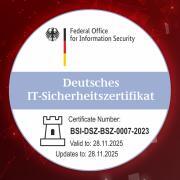
In a pilot project with the German Federal Office for Information Security (BSI) and the recognized testing laboratory secuvera, NoSpamProxy Server was the first software product and also an email security product to be tested and certified according to the BSZ procedure. The BSZ is based on intensive testing with real attack scenarios and penetration tests, in which the product is always considered in typical and real application scenarios.


You are currently viewing a placeholder content from Google Maps. To access the actual content, click the button below. Please note that doing so will share data with third-party providers.
More Information